Why Your Manufacturing Documentation is Already Out of Date

Andrew
•
Feb 20, 2026
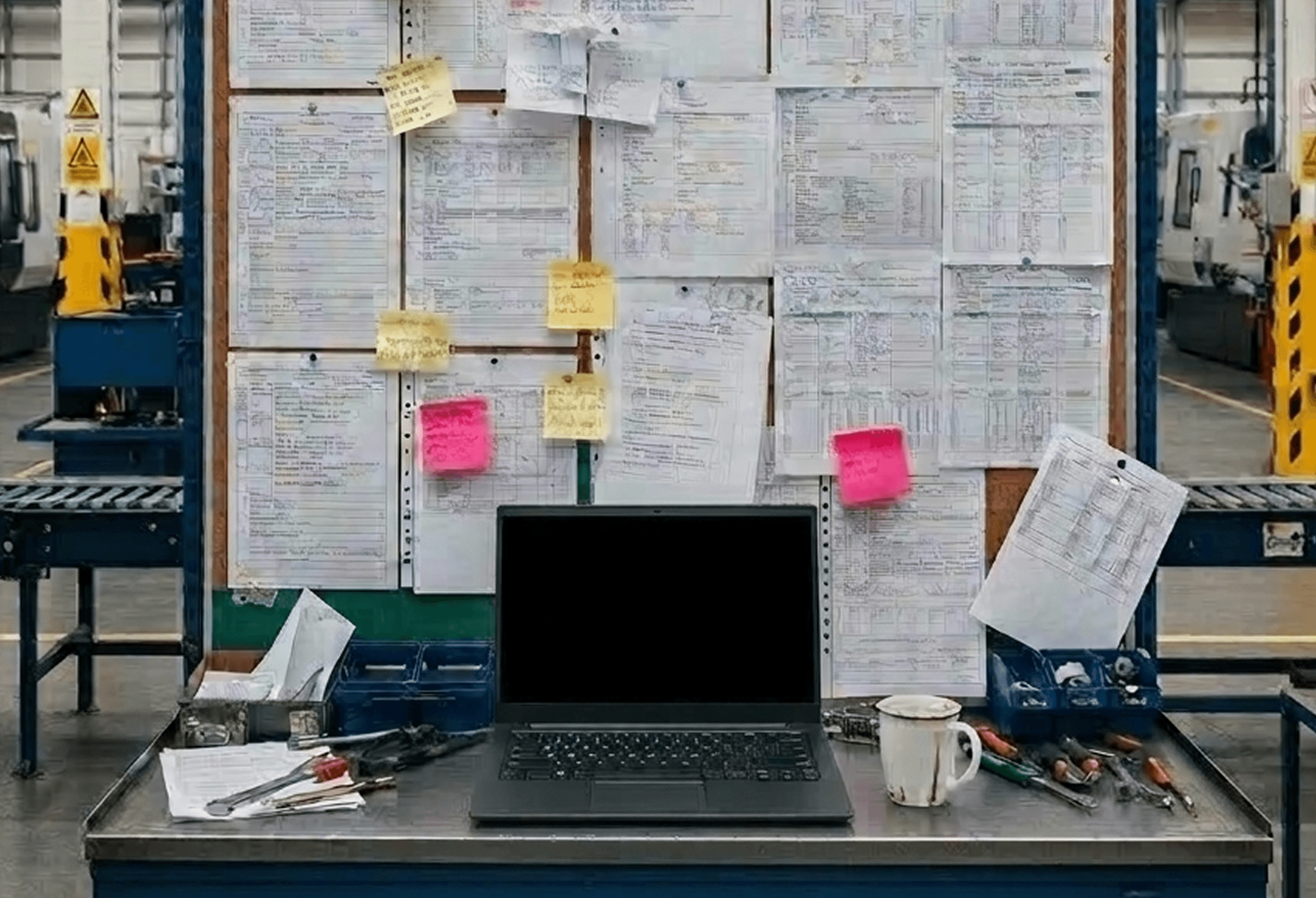
Monday, 6:15am. Sarah pulls up the assembly procedure for Line 3. Three weeks ago, your engineering team cut 15% off the cycle time with a new fixture design. Sarah's screen shows the old method.
She follows what's written. So do the other two operators on her shift. By lunch, you've built 47 units the wrong way.
This happens in factories every day. Process improvements roll out. Documentation updates don't keep pace. People work from instructions that stopped being accurate weeks or months ago. Nobody notices until something breaks.
Manufacturing runs on documentation. When procedures fall behind reality, the whole system starts to fail.
The Faster You Improve, The Worse It Gets
Most documentation problems come from success, not failure. You optimise a process. You update equipment settings. An operator suggests a better sequence. A supplier changes a specification. Each improvement makes your operation better and your documentation worse.
The work happens on the factory floor. The documentation lives in SharePoint. The two things exist separately. The work changes constantly. The documentation changes slowly. The gap between them grows.
Companies try to close this gap with discipline. Assign documentation owners. Build approval workflows. Schedule quarterly reviews. These help, but they can't solve the underlying problem: updating documentation takes too long.
Consider what happens when a process changes. Someone needs to notice the change happened. Someone needs to find time to document it. Someone needs to locate the master copy. Multiple people need to review the update. Someone needs to tell everyone affected. Everyone needs to replace their old copies.
By the time you've finished, the process has probably changed again.
What This Actually Costs
The cost of outdated documentation doesn't appear as a line item on your P&L. It accumulates across your operation in ways that are easy to miss but expensive to ignore.
Research from IDC found that knowledge workers spend 2.5 hours per day—30% of their workday—searching for information. Manufacturing floor staff search less than office workers, but they still hunt for procedures, check manuals, and track down specifications. That's productive time lost to navigation instead of work.
The bigger cost shows up in quality. The American Society for Quality places the total Cost of Quality at 15-20% of sales for most manufacturers. When operators follow outdated procedures, use wrong specifications, or work with gaps in their training, defects follow. The portion of quality failures that trace back to documentation issues represents a significant chunk of operational waste.
Then there's knowledge loss. Make UK's 2025 research found that 92% of UK manufacturing SMEs face skills gaps, with 55,000 unfilled long-term vacancies across the sector. When experienced workers leave and their knowledge isn't documented, replacement becomes more expensive and new hires take longer to reach competency.
Add in compliance burden (audit preparation, consultant fees, certification costs), health and safety documentation requirements, and extended onboarding time, and the total becomes substantial.
Our analysis of mid-market UK manufacturers shows that poor documentation typically costs between 3% and 3.5% of revenue. For a £15 million manufacturer, that's roughly £450,000 per year. For a £30 million business, it's close to £1 million. For a £100 million operation, it's over £3 million.
Most of this cost is hidden. It doesn't trigger alerts. It accumulates in rework, time searching, quality escapes, and knowledge that walks out the door when people leave.
When Delays Compound
Every time you delay a documentation update, the cost of that delay grows. More people work from wrong information. The gap between documents and reality widens. Updating becomes more daunting, so you delay longer. Tribal knowledge becomes the real reference.
New hires learn that written procedures can't be trusted. They ask experienced operators instead. This works until those operators leave. Then the knowledge leaves with them. You're left with documentation nobody trusts and no reliable source of truth.
AI Eliminates The Lag
Better processes won't fix this. The problem isn't discipline or ownership. The problem is time. Updates take too long because they require too much manual work.
AI can close the gap by handling the mechanical parts of documentation. It can't write your procedures for you. It can't make process decisions. But it can eliminate most of the delay between a change happening and documentation reflecting that change.
Modern AI systems can monitor operations and flag when processes diverge from documentation. They watch production data, quality records, engineering changes, and operator feedback. When something changes, they notice. You find out in real time instead of during the next audit.
AI can draft documentation updates based on actual practice. An engineer reviews and approves instead of writing from scratch. What took hours takes minutes. The system tracks which version was current when each batch ran. Traceability becomes automatic.
Operators can ask questions and get answers from current approved documents. They don't need to know where files are stored or which version is latest. The system handles that. Everyone works from the same information.
Documentation becomes a living system instead of a static snapshot. Updates propagate automatically. Changes sync across the organisation. The lag disappears.
What Changes When Documentation Stays Current
Consider what becomes possible. An operator asks about a torque specification. The system provides the current value from the approved procedure. No searching through folders. No wondering if the information is current. No asking around.
An engineer updates a process parameter. The system drafts a procedure update and routes it for approval. The change takes minutes instead of weeks. The new procedure reaches the floor the same day.
A quality issue emerges. You need to know which procedure version was active when the affected batch ran. The system shows you immediately. You can trace exactly what instructions operators followed.
An auditor asks to see evidence that operators work from current procedures. You demonstrate that the system provides only current versions and tracks every access. The finding you expected doesn't materialise.
Your documentation stops lagging behind your operation. It moves in sync with reality. People start trusting it again. New hires can rely on written procedures. Experienced operators don't need to be walking reference manuals. Knowledge stays in the system instead of leaving with people.
The Cost Of Waiting
Your documentation is already out of date. Operators are working from incomplete information right now. Quality issues are accumulating. Knowledge is walking out the door. The cost is real—somewhere between 2% and 4% of your revenue, depending on how mature your systems are.
AI won't solve every documentation problem. It won't eliminate the need for human judgment. It won't write perfect procedures automatically. But it can solve the fundamental issue: keeping documentation current with operational reality.
That matters. In modern manufacturing, outdated documentation isn't just an inconvenience. It's a systematic failure that touches quality, compliance, efficiency, and knowledge retention.
You can fix it now, or you can keep managing the gap. The gap isn't getting smaller on its own.
Monday, 6:15am. Sarah pulls up the assembly procedure for Line 3. Three weeks ago, your engineering team cut 15% off the cycle time with a new fixture design. Sarah's screen shows the old method.
She follows what's written. So do the other two operators on her shift. By lunch, you've built 47 units the wrong way.
This happens in factories every day. Process improvements roll out. Documentation updates don't keep pace. People work from instructions that stopped being accurate weeks or months ago. Nobody notices until something breaks.
Manufacturing runs on documentation. When procedures fall behind reality, the whole system starts to fail.
The Faster You Improve, The Worse It Gets
Most documentation problems come from success, not failure. You optimise a process. You update equipment settings. An operator suggests a better sequence. A supplier changes a specification. Each improvement makes your operation better and your documentation worse.
The work happens on the factory floor. The documentation lives in SharePoint. The two things exist separately. The work changes constantly. The documentation changes slowly. The gap between them grows.
Companies try to close this gap with discipline. Assign documentation owners. Build approval workflows. Schedule quarterly reviews. These help, but they can't solve the underlying problem: updating documentation takes too long.
Consider what happens when a process changes. Someone needs to notice the change happened. Someone needs to find time to document it. Someone needs to locate the master copy. Multiple people need to review the update. Someone needs to tell everyone affected. Everyone needs to replace their old copies.
By the time you've finished, the process has probably changed again.
What This Actually Costs
The cost of outdated documentation doesn't appear as a line item on your P&L. It accumulates across your operation in ways that are easy to miss but expensive to ignore.
Research from IDC found that knowledge workers spend 2.5 hours per day—30% of their workday—searching for information. Manufacturing floor staff search less than office workers, but they still hunt for procedures, check manuals, and track down specifications. That's productive time lost to navigation instead of work.
The bigger cost shows up in quality. The American Society for Quality places the total Cost of Quality at 15-20% of sales for most manufacturers. When operators follow outdated procedures, use wrong specifications, or work with gaps in their training, defects follow. The portion of quality failures that trace back to documentation issues represents a significant chunk of operational waste.
Then there's knowledge loss. Make UK's 2025 research found that 92% of UK manufacturing SMEs face skills gaps, with 55,000 unfilled long-term vacancies across the sector. When experienced workers leave and their knowledge isn't documented, replacement becomes more expensive and new hires take longer to reach competency.
Add in compliance burden (audit preparation, consultant fees, certification costs), health and safety documentation requirements, and extended onboarding time, and the total becomes substantial.
Our analysis of mid-market UK manufacturers shows that poor documentation typically costs between 3% and 3.5% of revenue. For a £15 million manufacturer, that's roughly £450,000 per year. For a £30 million business, it's close to £1 million. For a £100 million operation, it's over £3 million.
Most of this cost is hidden. It doesn't trigger alerts. It accumulates in rework, time searching, quality escapes, and knowledge that walks out the door when people leave.
When Delays Compound
Every time you delay a documentation update, the cost of that delay grows. More people work from wrong information. The gap between documents and reality widens. Updating becomes more daunting, so you delay longer. Tribal knowledge becomes the real reference.
New hires learn that written procedures can't be trusted. They ask experienced operators instead. This works until those operators leave. Then the knowledge leaves with them. You're left with documentation nobody trusts and no reliable source of truth.
AI Eliminates The Lag
Better processes won't fix this. The problem isn't discipline or ownership. The problem is time. Updates take too long because they require too much manual work.
AI can close the gap by handling the mechanical parts of documentation. It can't write your procedures for you. It can't make process decisions. But it can eliminate most of the delay between a change happening and documentation reflecting that change.
Modern AI systems can monitor operations and flag when processes diverge from documentation. They watch production data, quality records, engineering changes, and operator feedback. When something changes, they notice. You find out in real time instead of during the next audit.
AI can draft documentation updates based on actual practice. An engineer reviews and approves instead of writing from scratch. What took hours takes minutes. The system tracks which version was current when each batch ran. Traceability becomes automatic.
Operators can ask questions and get answers from current approved documents. They don't need to know where files are stored or which version is latest. The system handles that. Everyone works from the same information.
Documentation becomes a living system instead of a static snapshot. Updates propagate automatically. Changes sync across the organisation. The lag disappears.
What Changes When Documentation Stays Current
Consider what becomes possible. An operator asks about a torque specification. The system provides the current value from the approved procedure. No searching through folders. No wondering if the information is current. No asking around.
An engineer updates a process parameter. The system drafts a procedure update and routes it for approval. The change takes minutes instead of weeks. The new procedure reaches the floor the same day.
A quality issue emerges. You need to know which procedure version was active when the affected batch ran. The system shows you immediately. You can trace exactly what instructions operators followed.
An auditor asks to see evidence that operators work from current procedures. You demonstrate that the system provides only current versions and tracks every access. The finding you expected doesn't materialise.
Your documentation stops lagging behind your operation. It moves in sync with reality. People start trusting it again. New hires can rely on written procedures. Experienced operators don't need to be walking reference manuals. Knowledge stays in the system instead of leaving with people.
The Cost Of Waiting
Your documentation is already out of date. Operators are working from incomplete information right now. Quality issues are accumulating. Knowledge is walking out the door. The cost is real—somewhere between 2% and 4% of your revenue, depending on how mature your systems are.
AI won't solve every documentation problem. It won't eliminate the need for human judgment. It won't write perfect procedures automatically. But it can solve the fundamental issue: keeping documentation current with operational reality.
That matters. In modern manufacturing, outdated documentation isn't just an inconvenience. It's a systematic failure that touches quality, compliance, efficiency, and knowledge retention.
You can fix it now, or you can keep managing the gap. The gap isn't getting smaller on its own.
See what the future of operating documents looks like
See what the future of operating documents looks like
Document faster, train smoother, audit cleaner and transform your business using a platform built for modern work.
